Error
404 - File Not Found
We’re sorry, the page you are looking for:
...was not found on our servers. Please check the URL to ensure that the path is correct.
We’re sorry, the page you are looking for:
...was not found on our servers. Please check the URL to ensure that the path is correct.
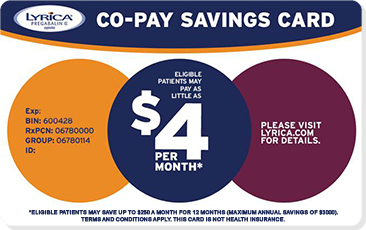
Eligible patients may pay as little as $4
per Rx with the Co-Pay Savings Card.†
By using the Co-Pay Savings Card, you acknowledge that you currently meet the eligibility criteria and will comply with the following terms and conditions:
Patients are not eligible to use this card or participate in this program if they are enrolled in a state or federally funded insurance program, including but not limited to Medicare, Medicaid, TRICARE, Veteran Affairs healthcare, a state prescription drug assistance program, or the Government Health Insurance Plan available in Puerto Rico (formerly known as “La Reforma de Salud”). Patient must have private insurance. Offer is not valid for cash-paying patients. The value of this card is limited to $250 per month per prescription (“offering period”) or the amount of your co-pay, whichever is less (maximum annual savings of $3000). This program is not valid when the entire cost of your prescription drug is eligible to be reimbursed by your private insurance plan or other private health or pharmacy benefit programs. You must deduct the value received under this program from any reimbursement request submitted to your private insurance plan, either directly by you or on your behalf. You are responsible for reporting use of this program to any private insurer, health plan, or other third party who pays for or reimburses any part of the prescription filled using the program, as may be required. You should not use the program if your insurer or health plan prohibits use of manufacturer co-pay cards. You must be 18 years of age or older to accept this offer. This offer is not valid where prohibited by law.
For Massachusetts residents:This co-pay offer is not valid if an A/B generic is available for Massachusetts residents whose prescriptions are covered in whole or in part by third-party insurance.
For California residents:This co-pay offer is not valid if a generic is available for California residents whose prescriptions are covered in whole or in part by third-party insurance.
Please check with your healthcare professional or insurer to confirm eligibility. This offer cannot be combined with any other savings, free trial or similar offer for the specified prescription. The co-pay card will be accepted only at participating pharmacies. The co-pay card is not health insurance. Offer good only in the US and Puerto Rico. The co-pay card is limited to one per person during this offering period and is not transferable. A co-pay card may not be redeemed more than once per offering period per patient. No other purchase is necessary. Data related to your redemption of the co-pay card may be collected, analyzed, and shared with Viatris, for market research and other purposes related to assessing Viatris’s programs. Data shared with Viatris will be aggregated and de-identified; it will be combined with data related to other co-pay card redemptions and will not identify you. Viatris reserves the right to rescind, revoke, or amend this offer without notice. No membership fee. For more information, visit our website www.LYRICA.com, call 1-866-954-1475, or contact us at 2250 Perimeter Park Drive, Suite 300, Morrisville, NC 27560.
Offer expires 12/31/2024.
For reimbursement when using a nonparticipating pharmacy/mail order:Pay for prescription, and mail copy of original pharmacy receipt (cash register receipt NOT valid) with product name, date, and amount circled to: Co-Pay Savings Card, 2250 Perimeter Park Drive, Suite 300, Morrisville, NC 27560. Be sure to include a copy of the front of your activated Co-Pay Savings Card, your name and mailing address.
By agreeing to the terms of LSAVINGS E-mail program (the “E-mail Program”), you consent to receive e-mail messages on behalf of Viatris. Consent is not a condition of purchase or use of any Viatris product or service.
Data obtained from you in connection with your registration for, and use of, the E-mail Program may include your e-mail address and elements of pharmacy claim information, such as name, date of birth, and prescription information. You agree that such data may be used to administer the E-mail Program and to provide E-mail Program benefits such as savings offers, information about your prescription, including refill reminders and new prescription requests, as well as E-mail Program updates and alerts sent directly to your e-mail address.
You may unsubscribe from the E-mail Program at any time by clicking on the unsubscribe link at the bottom of any E-Mail Program e-mail. Please do not reply to E-mail Program e-mails as it is an unattended e-mail box. A link to contact Viatris is at the bottom of every E-mail Program e-mail. Viatris reserves the right to rescind, revoke, or amend the E-mail Program without notice.
YOU ARE LEAVING LYRICA.COM, A VIATRIS INC., COMPANY WEBSITE
Links to another site are provided as a convenience to the viewer.
YOU ARE LEAVING LYRICA.COM, A VIATRIS INC., COMPANY WEBSITE
The information provided in LyricaHCP.com is intended only for healthcare professionals in the United States.


